Reduce Automatic Smoking with Smoke Loop Intercept
If “just quit” advice keeps failing, the problem may not be motivation at all. Smoke Loop Intercept gives you a mechanical way to pause the automatic reach, check your pacing, and track where your easiest cuts actually are. This page walks that system through one real cigarette event so you can see how reduction works without turning it into a willpower contest.
Smoke Loop Intercept is a behavioral smoking-reduction system that inserts a 36-second pause before a cigarette, then uses a pacing check to help you delay, log, or proceed consciously instead of smoking on autopilot. It is not a medical treatment or a quit guarantee. The page explains how the intercept works in one event, then shows how shields, tagging, heatmaps, and weakest-slot targeting turn repeated pauses into a practical reduction plan.
What Smoke Loop Intercept looks like in one real
cigarette event
An abstract framework is useless when physical tension spikes. It helps to see it applied to a single, ordinary moment. During development, I tested the mechanics on my own ingrained routines.
I was at my desk right after wrapping up a dense PhD research session. The moment started when I closed the laptop lid. My default next move would have been to reach into my right pocket for the lighter, grab the pack from the desk drawer, and walk out to the balcony on pure muscle memory.
Instead, I picked up my phone from the desk, unlocked the screen, and tapped to log a cigarette. The app immediately inserted its first circuit breaker: a 36-second breathing sequence. In my experience, this short pause gave the initial reflex enough space to settle.
After the breathing sequence, the app showed the pacing decision screen, displaying my time since the last cigarette. Because I had cleared my expected gap, I had options. I chose to deploy a postponement shield instead of smoking. Later, I added optional context tags—recording "Work Break" and noting my self-reported urge strength.
This worked because the system did not demand absolute denial. It inserted a structured, mechanical pause, giving me a moment to review my pacing status and make a conscious choice before taking physical action.
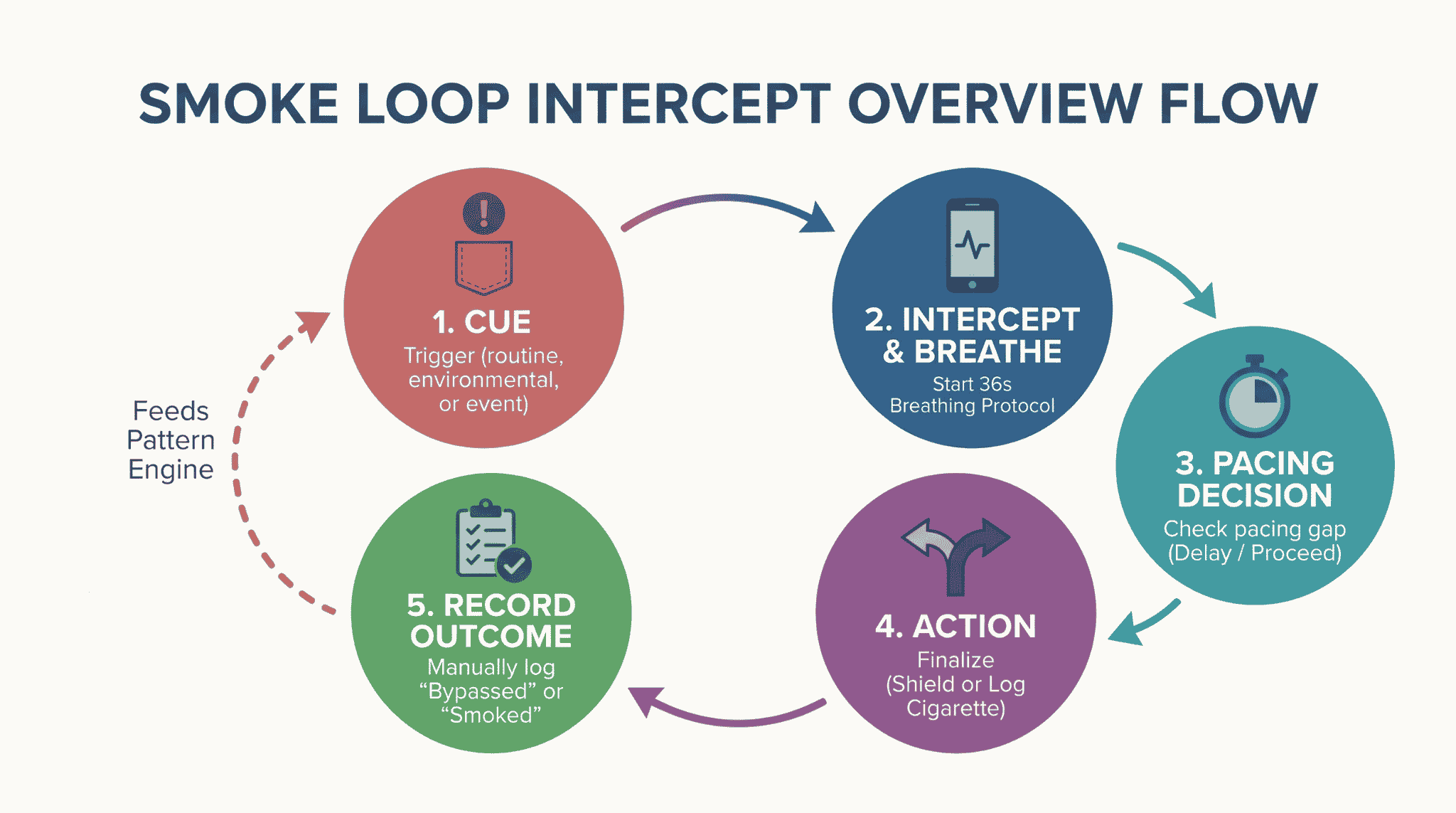
The sequence: cue, intercept, pacing decision, action,
and tagging
When stripped down to its operational core, a single intercept event follows an exact, repeatable order of operations:
1. Cue: A specific environmental, routine, or time-based event occurs.
2. Intercept & Breathe: You manually open the app and tap to log a cigarette. The system presents a 36-second breathing protocol to physically pause the automatic reach.
3. Pacing Decision: The app displays your current pacing gap. Depending on your status, you decide whether to log the cigarette, deploy a postponement shield, or continue holding the gap.
4. Action: You finalize the event by completing a shield or logging the cigarette entry.
5. Context Tagging (Optional): You add routine details, place, and urge strength to feed your pattern map.
The Intercept: where the automatic loop gets interrupted
Inserting a deliberate break in automaticity is a core model choice for this system. The framework is heavily informed by established behavioral models of the "habit loop," which identify that automatic behaviors operate on a cycle of a cue, a routine, and a reward. Requiring a mechanical input at the exact moment a cue hits interrupts the established motor sequence, preventing the routine from firing unchecked.
Smoke Loop Intercept does not use one fixed delay for every situation. Instead, it uses a suite of specific timing mechanisms depending on where you are in your biological day:
- 36-Second
Breathing Protocol: The default immediate pause when you initiate a
log.
- Pacing
Gap and Baseline Defense: A dynamic timer based on the expected
elapsed time between your cigarettes.
- Postponement
Shields: Longer holding blocks—commonly 30 minutes or based on the
remaining pacing interval—offered when you have cleared an expected gap.
- Morning
Anchor Blocks: 30-minute periods designed to manage the critical first
cigarette of your biological day.
- Sleep
Perimeter: A two-hour holding window before your configured sleep
time, complete with its own warnings and smoking costs.
- 15-Minute Weakest-Slot Delay: A targeted delay applied specifically to your most workable recurring trigger.
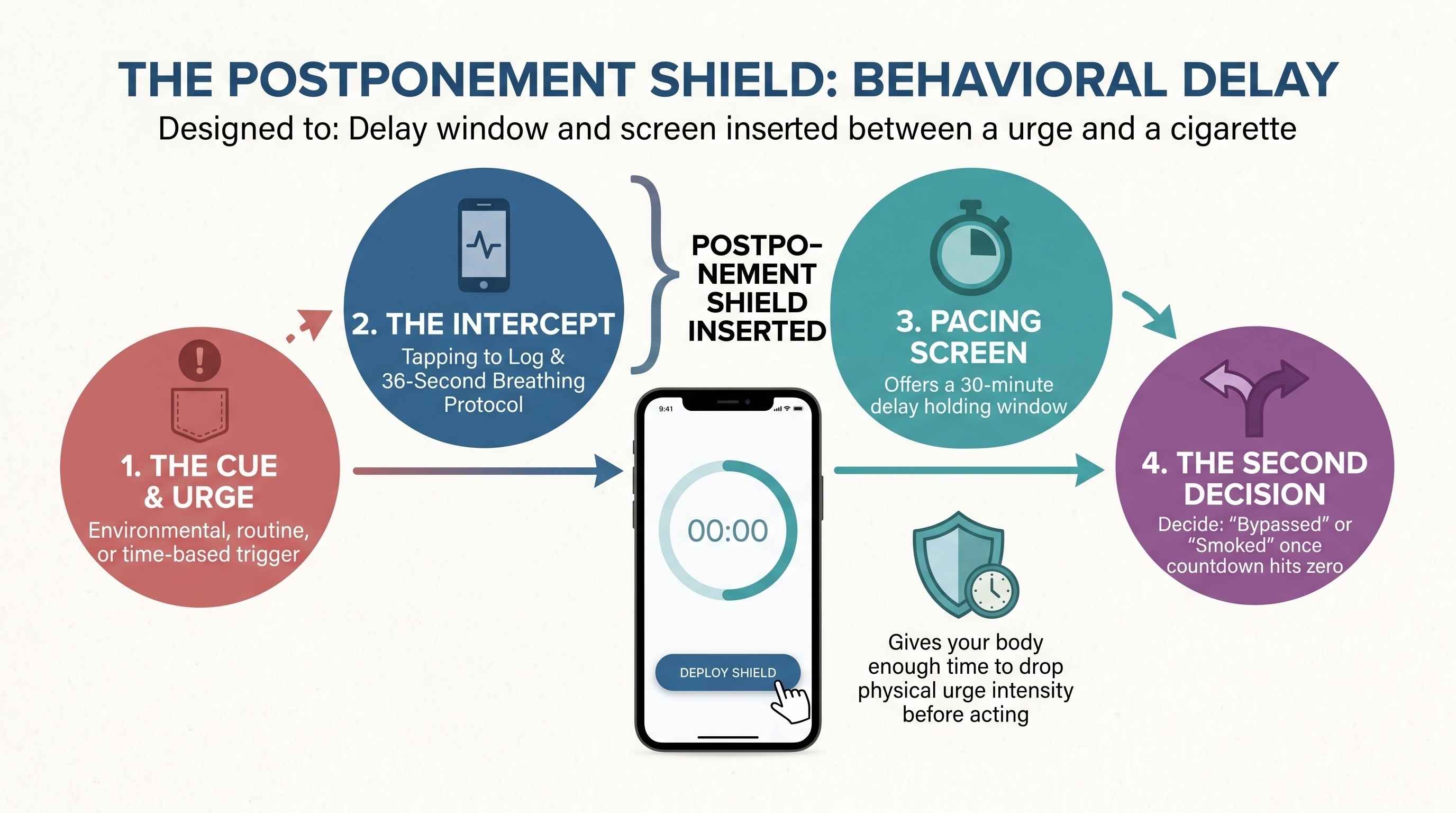
The Postponement Shield: creating space in the moment
The Postponement Shield relies on structured holding blocks to give you a behavioral choice when an urge hits. This mechanical delay borrows from the psychological concept of "urge surfing," pioneered by Dr. G. Alan Marlatt, which suggests that observing an urge and creating a small gap between the feeling and the action can change how much power a craving has over your decisions. Research also indicates that deliberately delaying smoking can help manage the intensity of cravings by forcing a pause in the behavioral cycle. (For details on configuring these timers, see Mechanical urge delay timer techniques).
I used this frequently during my evening commute, a daily bottleneck that consistently triggered a cigarette.
Critical Safety Note: Do not use the app while driving or while responsible for traffic safety. Set up the protocol before traveling, use a legal hands-free method only where appropriate, or wait until you are safely parked.
Because interacting with a phone in traffic is unsafe, I adjusted my protocol. After pulling into my driveway and putting the car in park, the urge to smoke before going inside was still sharp. I tapped to log, completed the 36-second breathing sequence, and chose to deploy a postponement shield.
Some users may find that the urge changes during the delay. For me, knowing the system's core rule explicitly permitted me to smoke once the shield was complete removed the panic of permanent denial. When the shield finished, I felt the moment's intensity had passed, so I skipped the cigarette and went inside.
Postponements and shield completions are tracked separately as pacing and recovery activity. They are incredibly useful for building behavioral delay, but they are recorded differently than a completed cigarette entry.
Peak Friction Heatmap: what repeated tracking reveals
The Peak Friction Heatmap groups your recent cigarette entries to reveal visible pattern clusters. It looks at a recent seven-day window and anchors the data to your specific biological waking time, rather than using generic clock hours.
Context tagging is optional. You can log an entry quickly without filling in every field. However, when you do log routine tags (like "Commute" or "Work Break") and self-reported urge intensity, the Heatmap becomes much more useful.
In my own longer-running review of the data, repeated patterns became easier to recognize after several days of consistent logging. The app’s current heatmap—focusing on the most recent seven-day window—showed dense clusters in specific wake-time-anchored blocks.
The data revealed that my highest-frequency spots weren't random; they clustered heavily around the “After Meal”, "Work Break" and "Commute", and morning coffee routines. Seeing this localized data changed how I operated. Instead of trying to suppress generalized cravings all day, I only had to prepare for those specific bottlenecks.
The Heatmap can reveal repeated clusters, high-count hotspots, isolated spikes, and average self-reported urge strength. It relies on completed cigarette entries to build this map.
Adaptive Tapering: how the data changes the reduction
plan
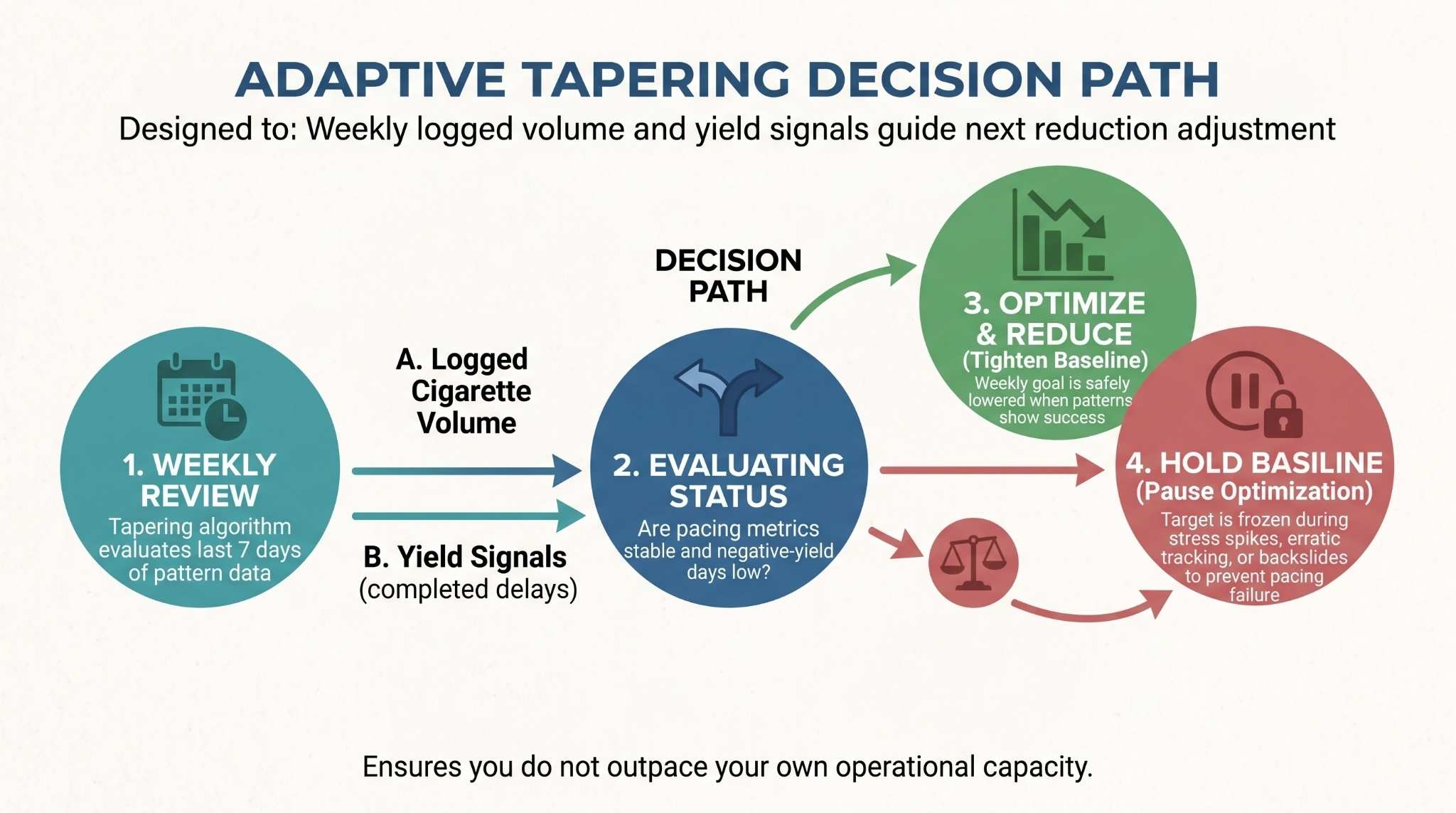
Rather than enforcing a static reduction schedule, the Adaptive Taper reviews recent cigarette volume and signals weekly to the system. Clinical reviews confirm that gradual smoking reduction prior to quitting completely is a valid, evidence-based approach for individuals managing ingrained smoking habits.
- Lower
the target: If the recent pattern of logged entries and pacing data
supports a lower target, the weekly goal can move down.
- Pause optimization: If negative-yield days accumulate or signals are unstable, the taper pauses rather than continuing to tighten. A paused taper remains frozen until your behavioral baseline stabilizes.
It requires stable, repeating pattern data to justify a reduction cut, ensuring you do not outpace your own operational capacity.
Weakest-Cigarette-First: targeting the easiest reduction
slot
Standard cessation advice often demands you tackle your hardest triggers immediately. The Weakest-Cigarette-First feature reverses this by identifying a recurring time block that appears more workable than your other smoking windows.
The system describes this target as contextually driven rather than chemically driven. In my data, it identified my mid-afternoon, post-lunch window as a weak slot. Before tracking, I assumed every cigarette was equally entrenched. However, my data showed the actual self-reported urge for that specific block was consistently low.
When the system flags this workable block, it offers a targeted 15-minute delay and tracks your successful attempts. It awards stars for successful delays, gamifying the resistance in your path of least resistance.
Targeting an easier smoking window is a highly practical behavioral strategy. It allows you to practice mechanical delay and build pacing discipline in a low-friction environment before taking on your hardest, most entrenched routines.
[How to Stop Chain-Smoking Before Cigarette #2]
Frequently asked questions
Does this system guarantee I will quit smoking?
No. It is a behavioral logging and pacing framework designed to insert pauses and map trigger patterns. It does not replace medical intervention or guarantee quitting.
Do I have to record context tags for every single cigarette?
No. Context tagging is optional. You can still log an entry quickly without filling in every field. However, more complete tagging makes the Heatmap pattern view significantly more useful for identifying your specific routine bottlenecks.
What if I complete a postponement shield but still smoke afterward?
The system records your completed shield separately from a logged cigarette entry. Completing a shield is a successful pacing delay and is rewarded by the system. Logging a cigarette afterward populates your Heatmap. Both provide valuable behavioral tracking signals.
Click for Troubleshoot Repeat Failures of Smoke Loop Intercept
System References
- Urge Surfing: How to Ride Out a Craving Without Giving In. Amelior Labs. Visit Link →
- The Habit Loop: Cue, Routine, Reward Explained. HabitBox. Visit Link →
- Smoking reduction interventions for smoking cessation. National Institutes of Health (NIH) / PMC. Visit Link →
- Anhedonia: Its Dynamic Relations With Craving, Negative Affect, and Smoking. National Institutes of Health (NIH) / PMC. Visit Link →

About Saqib Ali Ateel:
Saqib Ali Ateel is a senior systems analyst and the Chief Architect of SmokeTally & Smoke Loop Intercept App. Drawing on his executive oversight of public infrastructures serving millions and his research as a PhD Scholar, he engineered the Smoke Loop Intercept Protocol to dismantle the smoking habit loop using objective telemetry rather than willpower or counseling theater. A former heavy smoker, Saqib utilized these precise mechanical baselines to intercept his own neurochemical hardware. When not working in official capacity or working on his PhD, he studies intersection of physics, biology, and human agency. Check Saqib’s details on LinkedIn.
- Home
- Triggers & Delays
- Smoke Loop Intercept