How to Troubleshoot a Smoke Loop Intercept That Fails at
the Same Step
When your attempt to break a cigarette habit loop keeps failing at the exact same point, your first instinct is to blame your lack of willpower. You must discard this response because guilt corrupts your diagnostic baseline. A repeat breakdown at the exact same timestamp or physical handoff is actually a high-value signal: it means you have found a fixed system fault, not a character flaw. Your job is to stop reading the failure as a verdict and start reading it as telemetry. When you treat the breakdown as a mechanical bottleneck, the intercept becomes adjustable rather than mysterious.
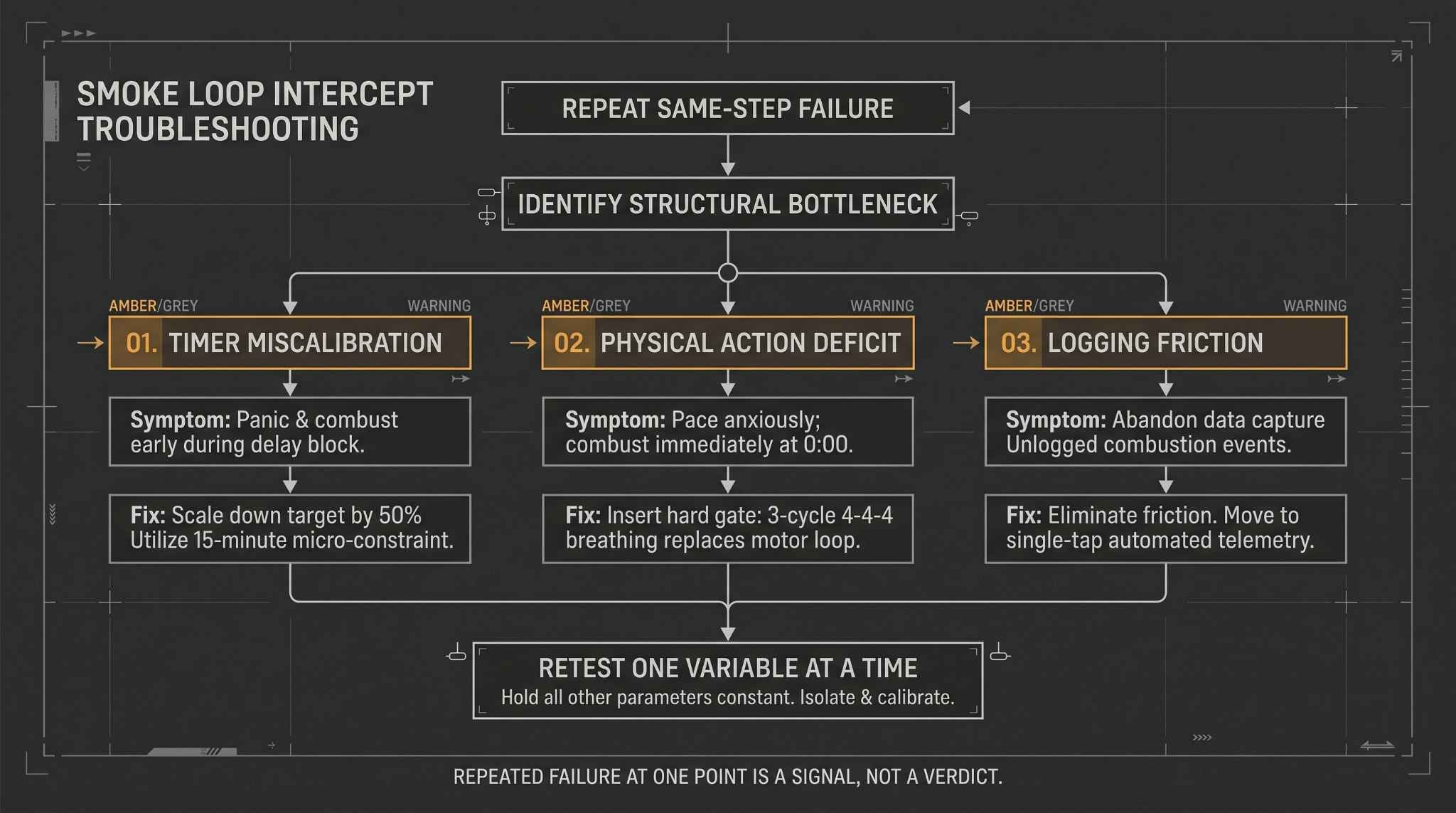
If your smoke loop intercept keeps failing at the exact same step, treat the breakdown as neutral telemetry data rather than a willpower failure. The most likely cause is a structural bottleneck in your timer calibration, physical replacement action, or logging friction. Use this diagnostic guide to isolate the specific system fault, apply a mechanical fix, and retest one variable at a time.
Treat the Repeat Failure as Data
A recurring breakdown at the exact same point is highly specific system telemetry waiting to be isolated. Extracting the emotion from a failed intercept allows you to see the mechanics underneath. Once you accept the failure as a neutral data point, you can move directly into the diagnostic checklist.
Failure signature: During the 3:00 PM work slump, marked by rapid task switching and an elevated heart rate, I ran a full 30-minute surplus block. The intercept consistently failed at the 15-minute mark. This pattern repeated for 5 consecutive days.
Initial interpretation: I initially treated the repeat failure as willpower depletion. Forcing compliance through brute mental effort only compounded failure and degraded protocol adherence.
Reframe trigger: The breakthrough was when I stopped evaluating my personal discipline and started evaluating the protocol architecture. A failure at the exact same timestamp, in the exact same conditions, is neutral telemetry data.
Diagnosis: This was a Timer Miscalibration fault. The combination of a physiological stress spike plus a full 30-minute surplus target created an invalid system configuration, producing a predictable structural bottleneck at the 15-minute mark.
Action implied by telemetry: Once treated as neutral telemetry data, the fix became a simple mechanical parameter adjustment. I downscaled the target to a 15-minute micro-constraint and reran the exact same sequence. The reduced delay block completed immediately.
Check for Timer Miscalibration
The first variable to inspect is your delay window calibration. A timer miscalibration occurs when the configured temporal gap exceeds the operator's current biological capacity to hold it under stress. Setting an aspirational surplus block during a peak cortisol spike is not discipline; it is a system error. Acute stress signaling rapidly impairs prefrontal cortex function, reducing the brain's capacity for behavioral inhibition and impulse control (Arnsten, 2009).
Immediate Fix: Scale down the next intercept target. If a full 30-minute block causes failure, utilize a 15-minute micro-constraint prompt. The structural goal is to successfully execute the mechanical delay, not to force a cold-turkey abstinence window. Scaling down the target ensures the loop completes successfully, logs a behavioral win, and establishes a baseline to build on.
Check for Physical Action Deficit
If the delay timer completes but the intercept still collapses at the zero mark, the fault is a Physical Action Deficit. You successfully created a temporal gap, but failed to provide a structural replacement for the basal ganglia. The motor loop remains primed and idling, waiting for the physical hand-to-mouth action to execute.
Failure signature: When the 15-minute micro-constraint countdown reached 0:00, I struck a lighter and initiated a smoking event within 5 seconds. There was zero cognitive transition or conscious override. This indicates the delay created a temporal gap, but merely paused the craving in the buffer rather than intercepting it. During the delay block, posture consisted of rapid, unstructured pacing. Hands continuously cycled through empty pockets, and the jaw remained tightly clenched. The body was physically simulating the absent ritual. Because the basal ganglia lacked a structured replacement task, the motor loop was left idling at high RPM. The basal ganglia are central to the execution of automated motor habits, requiring a physical substitution to successfully disrupt established pathways (Yin & Knowlton, 2006).
Diagnosis & Retest: Classified as a Physical Action Deficit: the failure to provide the motor pathways with a mechanical substitute during a temporal delay. To correct this, I inserted the System Stabilization Protocol as a hard mechanical gate. The app interface mechanically gates the decision matrix (blocking any ability to log a smoking event or deploy a shield) until the 3-cycle 4-4-4 breathing protocol completes or a tiered penalty-bearing bypass or Crisis Mode is consciously triggered. The minimum required action became a 4-4-4 breathing sequence (four seconds inhale, four seconds hold, four seconds exhale) repeated across three full breath cycles.
In the next run, pacing was mechanically blocked because the sequence required stationary thoracic control. At the end of the timer, the automatic lighting response did not fire. The failure signature was neutralized because the breathing protocol consumed the motor loop bandwidth while forcing an observable drop in physiological agitation (reduced pacing and jaw tension). Controlled, paced breathing protocols have been empirically shown to shift the autonomic nervous system toward parasympathetic dominance, neutralizing acute stress arousal (Zaccaro et al., 2018).
Check for Logging Friction
The final failure point occurs when the intercept successfully executes through the delay timer and the physical replacement action, but fails at the data capture step. Result: an unlogged cigarette event creates a data gap that corrupts your model, resulting in an open loop that distorts your baseline telemetry.
Logging friction breaks the protocol because the cognitive load of manually recording the data exceeds available prefrontal bandwidth during peak craving stress. This fault happens when the tracking step requires too many actions, such as unlocking a phone, finding a spreadsheet, or typing details, while operating under environmental constraints. If you are driving, working, or managing privacy, a multi-step manual log is an invalid system configuration for that context.
Failure Signature: A logging friction failure signature in a driving context
Baseline configuration: The context was a high-stress driving commute. The variables held constant were a 15-minute delay timer and the 4-4-4 breathing replacement action. The logging mechanism was a manual spreadsheet requiring device unlocking and typing.
Before and After signature: In the initial run, the timer and breathing executed successfully, but the protocol broke down at data capture. The physical and cognitive friction of navigating a spreadsheet while adhering to the strict protocol rule of zero visual or cognitive interaction while the vehicle is in motion caused me to abandon the log entirely.
Outcome: unlogged combustion event and corrupted telemetry. In the next run, I changed only the logging mechanism. Transitioning to a single-tap automated log allowed the loop to close successfully. The data point was captured instantly once the vehicle was safely stopped, proving the breakdown was strictly a friction overload at the data capture step.
Immediate Fix:
- Requirement: Data capture must execute via a single physical action without diverting visual attention while in motion.
- Implementation: Transition to automated tracking, such as the Smoke Loop Intercept app, which handles the timer and logs the data point with a single tap.
- Pass condition: The intercept loop closes only when the timer completes, the replacement action completes, and the telemetry capture succeeds.
Retest One Variable at a Time
To isolate a structural bottleneck, the operator must adjust only one mechanical variable per run and hold all others constant. If you change the timer, the replacement action, and the logging mechanism simultaneously, your telemetry becomes unreadable. Pick the single most likely point of failure from the troubleshooting matrix located directly above this section. Change only that parameter, run the intercept again under the exact same contextual conditions, and observe the outcome. This rigid diagnostic discipline ensures that when the loop finally closes, you know exactly which configuration secured the system.
Automate Your Telemetry: Deploy the Smoke Loop Intercept
App
Troubleshooting an intercept failure requires rigid baseline data, but manually tracking that data often causes the exact friction that breaks the loop. To eliminate cognitive load and run this protocol exactly as designed, operators should deploy the Smoke Loop Intercept application. Engineered specifically for this diagnostic framework, the app hardcodes your surplus blocks, manages your entropy/negentropy tracking, mechanically gates the decision matrix to enforce your replacement action, deploys shields, and captures your telemetry with a single tap. Stop losing data to logging friction.
Systems Reference
- Arnsten, A. F. T. (2009). Stress signalling pathways that impair prefrontal cortex structure and function. Nature Reviews Neuroscience, 10(6), 410-422. https://doi.org/10.1038/nrn2648
- Yin, H. H., & Knowlton, B. J. (2006). The role of the basal ganglia in habit formation. Nature Reviews Neuroscience, 7(6), 464-476. https://doi.org/10.1038/nrn1919
- Zaccaro, A., et al. (2018). How Breath Control Can Change Your Life: A Systematic Review on Psycho-Physiological Correlates of Slow Breathing. Frontiers in Human Neuroscience, 12, 353. https://doi.org/10.3389/fnhum.2018.00353

About Saqib Ali Ateel:
Saqib Ali Ateel is a senior systems analyst and the Chief Architect of SmokeTally & Smoke Loop Intercept App. Drawing on his executive oversight of public infrastructures serving millions and his research as a PhD Scholar, he engineered the Smoke Loop Intercept Protocol to dismantle the smoking habit loop using objective telemetry rather than willpower or counseling theater. A former heavy smoker, Saqib utilized these precise mechanical baselines to intercept his own neurochemical hardware. When not working in official capacity or working on his PhD, he studies intersection of physics, biology, and human agency. Check Saqib’s details on LinkedIn.
- Home
- Triggers & Delays
- Smoke Loop Intercept
- Troubleshoot a Smoke Loop Intercept That Fails