Trigger Interception & Urge Delay for Smoking
Reduction
Your hand is already moving before you've made a decision—that is where Trigger Interception & Urge Delay begins. A craving is not an all-day test of character; it is a short cue-spike-reach sequence that can be interrupted with a timer, a rule, or a few feet of distance. Once you treat the urge like a mechanical loop instead of a moral battle, the panic drops and the decision point comes back. This guide shows how to break the smoke loop in the moments that usually win: traffic, coffee, break windows, and workplace smoke circles.
Trigger Interception & Urge Delay is a mechanical way to break a smoking craving before it becomes an automatic cigarette. Instead of trying to overpower the urge, you insert a short timed pause and a physical buffer between the cue, the spike, and the reach. The delay does not need to be long; it needs to be repeatable under stress. Below, you'll see how to apply that in commutes, coffee routines, work breaks, and other high-risk moments.
The Mechanics of the Urge: Trigger, Spike, Reach
A smoking craving does not hit as a static, endless state. Every craving follows an identifiable three-stage loop:
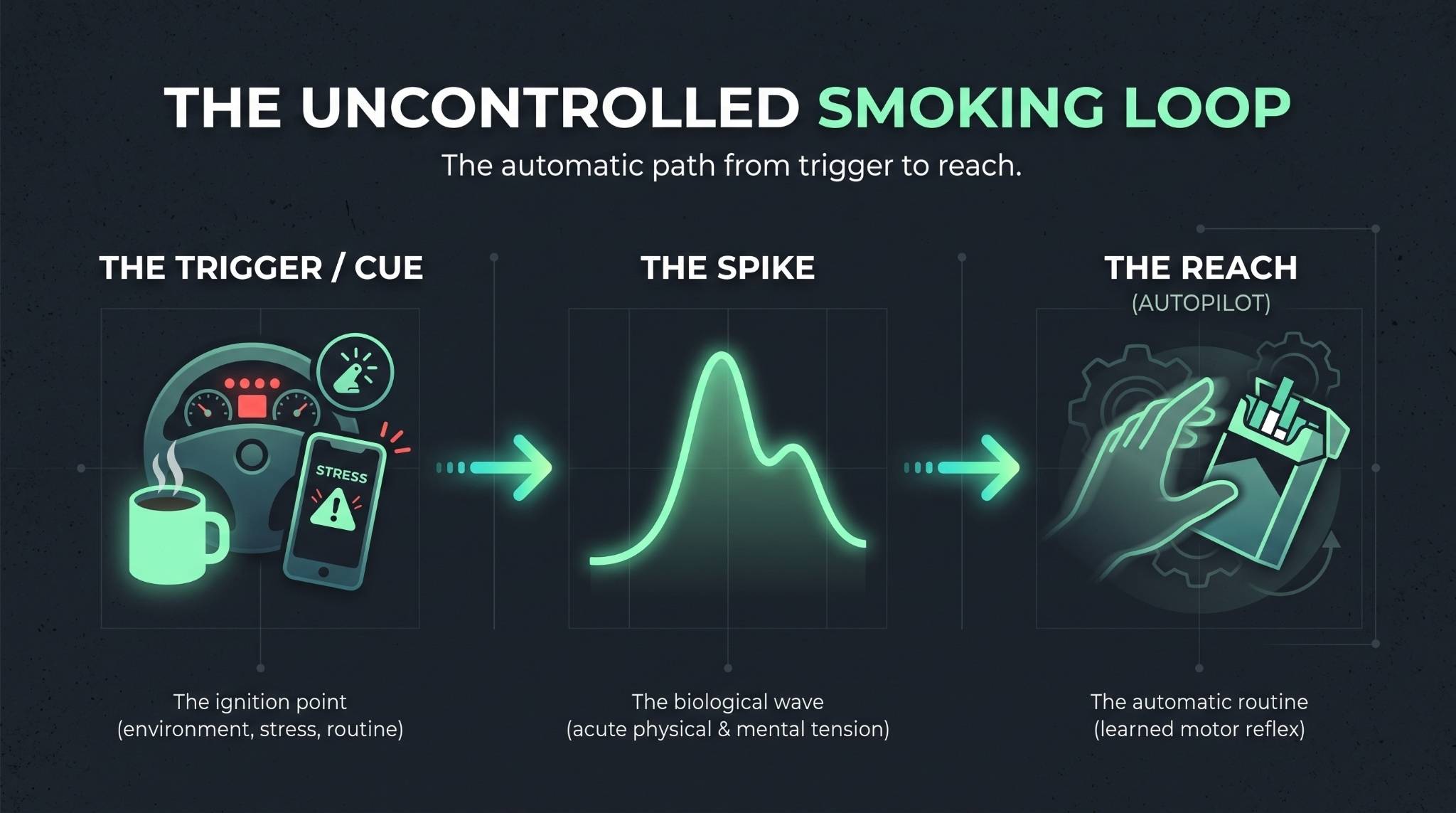
- Trigger (The Cue): The contextual ignition point. It
can be environmental (stepping into your car, hearing a lighter flick),
situational (ending a meeting, pouring coffee), or emotional (a sudden spike in
cortisol or frustration). Decades of addiction research confirm that these
specific cues reliably trigger acute physiological arousal and subjective
cravings (Carter & Tiffany, 1999).
- Spike (The Urge): The physiological surge. Nicotine
habituation creates physical and psychological tension. When experiencing this
tension, smokers often overestimate how long the urge will last and how intense
it will become, creating the illusion of an endless emergency (Sayette et al.,
2005). In reality, many acute craving waves rise and fall over several minutes,
though the timing varies from person to person.
- Reach (The Routine): The learned motor reflex. Over months and years of repetition, the physical motion of reaching into a pocket, opening a pack, and striking a lighter becomes an automatic motor routine that executes before your conscious mind intervenes (Shiffman et al., 2015).
Standard willpower-based cessation fails because it attempts to fight Stage 2 (The Spike) by enduring it passively. Interception flips this dynamic: you let the spike happen, but you use an objective mechanical rule to pause the reach.
Delay Cravings to Smoke: The Short Intercept Window
Surviving an acute urge does not require enduring hours of agony. It requires executing an active pause during the narrow window when the physical tension is at its peak. A three-to-five-minute delay gives you a short, manageable window to actively observe whether the urge changes before you act, effectively preventing the escalation of distress (Bowen & Marlatt, 2009).
The Commute Spike in Real Time
I was stuck in bumper-to-bumper evening traffic on the highway, boxed in with no option to pull over or exit. Brake lights flashed ahead, and my right hand reflexively reached toward the center console where the pack lived.
The urge felt like sudden chest pressure and immediate tunnel vision. Before the car moved, I had set a three-minute hands-free timer. When the urge appeared in traffic, I kept both hands on the wheel and followed the delay rule without touching the phone.
(Note: Never interact with a phone or timer while driving. Set any delay before departure, or enter your past smoking after you stop the vehicle or use a fully hands-free system.)
By minute three, the physical intensity started to decrease. My grip on the wheel loosened. The urge stopped feeling like an urgent command and dropped to a quiet background thought.
It proved that a craving spike does not build endlessly until you break (Sayette et al., 2005). It is a biological wave that often peaks and drops within a few minutes if you do not immediately reinforce it. When you are trapped in a car, you do not have to survive the rest of the day. You only have to execute a mechanical hold for the few minutes it takes for the wave to crest.
Mechanical Urge Delay Timer Techniques: Replacing Willpower with Rules
Passive waiting increases psychological tension. Sitting empty-handed while thinking "do not smoke" burns through finite mental energy. Active mechanical delay replaces internal debate with an objective protocol:
- Binary Execution: You do not decide whether you are strong enough to resist. You simply agree to execute a timed pause.
- The Permission Valve: You are allowed to smoke, but only after the timer expires. Removing absolute denial eliminates panic.
- External Anchoring: Watching an objective countdown shifts cognitive focus from internal tension to an external data point. Simply observing the urge, rather than immediately reinforcing it, can reduce craving intensity (Bowen & Marlatt, 2009).
The 2-Minute Break Hold
I had an eight-minute break between two dense work meetings, and running late was out of the question. The moment the first meeting ended, my hand dropped straight into my pocket, grabbed my lighter, and steered me toward the stairwell on autopilot.
Instead of stepping outside, I executed a mandatory two-minute hold rule: I was allowed to smoke, but only after an unnegotiable 120-second countdown. Two minutes was the sweet spot, small enough that my brain didn't rebel, but long enough to sever the automatic routine.
I paused at an empty desk in the hallway, started a silent two-minute timer on my phone, and took slow sips from a water bottle while watching the numbers drop. When the timer hit 0:00, the intensity had begun to reduce. I capped the bottle, turned around, and walked into the second meeting on time without smoking. A visible clock halts the physical reach long enough for the tension to shift.
Pattern Disruption: Decoupling Learned Daily Triggers
Cigarettes rarely exist in isolation; they are bound to daily transitions, physical sensory inputs, and rituals (Carter & Tiffany, 1999). Breaking the link does not require abandoning routines you enjoy. It requires inserting physical distance and micro-friction between the trigger and the lighter so the habit can no longer fire on autopilot.
The Coffee Routine Buffer
The first hot sip of morning coffee hit, and before the mug touched the counter, my fingers reached toward the microwave on pure reflex. The pack was there, but the lighter was stored down the hall behind two closed doors. My rule was simple: drink the first third of the mug and write three work priorities on the notepad already sitting by the sink before walking to get it.
For the first ninety seconds, the itch was sharp, and my free hand tapped the ceramic mug restlessly. By minute three, writing the tasks forced my attention forward. By the time I set the pen down, the urgent command had flattened into a background thought. I picked up my mug, walked straight to my desk, and never made the trip to the back room.
Adding twenty feet of physical distance and a brief task buffer doesn't ruin the morning ritual; it just holds off the reach to see if the urge breaks on its own.
Social and Environmental Interception: Maintaining
Low-Drama Control
One of the greatest points of failure for high-stress professionals is the social break. The smoking circle is frequently where informal updates happen. The mechanical answer is decoupling: keep the social ritual, but mechanically occupy the motor reflex.
Decoupling the Workplace Smoke Break
I was hunched over my monitor at 3:00 PM when a senior colleague rapped twice on my cubicle partition: "Stepping down for five, you coming?" The pressure wasn't just nicotine. It was the fear of looking antisocial and missing an informal workplace debrief. Instead of opening my desk drawer for the pack, I left it locked, grabbed a travel mug from my desk, and said, "Right behind you."
Down on the courtyard steps, I stood about two steps back from the landing where three of them flicked their lighters. When someone gestured with their pack toward me, I simply lifted the mug with both hands, took a sip, and shook my head once without breaking eye contact. Within two minutes, my shoulders dropped, and my focus shifted entirely into the work banter.
When the five minutes wrapped, we took the elevator back up together. I got the break and the conversation, while the pack stayed locked upstairs.
The Situational Protocol Directory
Every high-risk smoking trigger has its own operational profile, physical constraints, and friction points. Use the following situational blueprints to install custom interception buffers across your daily routine:
- Smoking
triggers list: Categorize environmental cues, physiological patterns,
and transition habits before deploying timers. [Printable Smoking Heatmap]
- Delay
cravings to smoke: Detailed instructions on identifying the onset of
the spike and letting the wave crest without physical action.
- Coffee
trigger smoking replacement routine: Step-by-step buffer architectures
for morning caffeine routines without abandoning your coffee habits.
- Driving
trigger smoking plan: Vehicle setup guides and hands-free micro-delay
protocols designed specifically for commutes.
- After-meal
smoking interruption: Disrupting the post-meal routine using immediate
palate cleansers and table exit rules.
- Mechanical
urge delay timer techniques: Comparing tactile mechanical timers and
interface designs to find the lowest-friction delay tool for your
workplace.
- Coworker
smoke break trigger tactics: Non-verbal refusal mechanics and physical
anchors to stay inside workplace social loops without taking a pull.
- Phone
call smoking trigger swap: Desk setup protocols to eliminate the
unconscious reach during long client or conference calls.
- Doorway transition smoking cue reset: Deconstructing the threshold reflex that fires when walking through building exits, parking structures, and transit gates.
Deploying a Structured Tracking System
If you find yourself renegotiating the same rules every time an urge appears, a structured tracking system can make the next step easier to repeat. Smoke Loop Intercept places a decision point inside the logging routine, offers a guided postponement window, and records the context so you can review which situations repeatedly pull you toward smoking.
To turn these personal rules into a repeatable tracking routine, the Smoke Loop Intercept framework offers a personal smoking ledger that goes beyond generic countdowns:
- Postponement
Shield: Creates a visible, timed delay window with a follow-up
decision at the end, rather than a simple countdown that disappears.
- Peak
Friction Heatmap: Combines time blocks, routine cues, urge intensity,
and day types into a visual pattern grid to map your highest-risk
triggers.
- Weakest-Cigarette-First
Targeting: Identifies a target time block and encourages you to delay
or remove the most removable cigarette first.
- Adaptive
Tapering: Adjusts weekly smoking reduction goals based on recorded
progress and pauses when performance becomes unstable.
- Time-Based Protocols: Utilizes structured boundaries like the Morning Anchor and Sleep Perimeter to manage transition periods.
To learn how to start guided delay windows, map your primary triggers, and review difficult high-frequency periods, explore our core method hub: Smoke loop intercept.
Bowen, S., & Marlatt, A. (2009). Surfing the urge: Brief mindfulness-based intervention for college student smokers. Psychology of Addictive Behaviors, 23(4), 666–671. https://doi.org/10.1037/a0017127
Carter, B. L., & Tiffany, S. T. (1999). Meta‐analysis of cue‐reactivity in addiction research. Addiction, 94(3), 327–340. https://doi.org/10.1046/j.1360-0443.1999.9433273.x
Sayette, M. A., Loewenstein, G., Kirchner, T. R., & Travis, T. (2005). Effects of Smoking Urge on Temporal Cognition. Psychology of Addictive Behaviors, 19(1), 88–93. https://doi.org/10.1037/0893-164x.19.1.88
Shiffman, S., Dunbar, M. S., Tindle, H. A., & Ferguson, S. G. (2015). Nondaily smokers’ experience of craving on days they do not smoke. Journal of Abnormal Psychology, 124(3), 648–659. https://doi.org/10.1037/abn0000063

About Saqib Ali Ateel:
Saqib Ali Ateel is a senior systems analyst and the Chief Architect of SmokeTally & Smoke Loop Intercept App. Drawing on his executive oversight of public infrastructures serving millions and his research as a PhD Scholar, he engineered the Smoke Loop Intercept Protocol to dismantle the smoking habit loop using objective telemetry rather than willpower or counseling theater. A former heavy smoker, Saqib utilized these precise mechanical baselines to intercept his own neurochemical hardware. When not working in official capacity or working on his PhD, he studies intersection of physics, biology, and human agency. Check Saqib’s details on LinkedIn.