Morning Coffee Cigarette:
5-Minute Intercept Protocol
The smoke loop intercept protocol for the morning coffee cigarette starts at the empty cup, not at the craving. This protocol is designed for the private, hidden smoker who wants objective control—using pocket tallies and mechanical pacing—without counseling, confession, or surveillance. The second your last sip is gone, you force a mechanical gap that turns an automatic morning reflex into something you can interrupt, measure, and eventually break.
Protocol Summary
To build a smoke loop intercept protocol for the morning coffee cigarette, start the intervention the instant your cup is empty, not when you wake up or take the first sip. Stand up, leave the room, start a strict 5-minute timer, and run three rounds of 4-4-4 breathing before you allow ignition. This guide shows how to use that wedge, recover from an automatic reach, and log the delay.
Run the 5-minute System Stabilization wedge tomorrow
morning
This is a mechanical intervention. Do not try to out-think the craving, and do not rely on vague instructions to "delay your smoke." To break this loop, define an unnegotiable physical start point. When the coffee is gone, execute these steps in order.
1. Break visual contact: The exact second you swallow your final sip and the empty mug hits the table, stand up immediately and leave the room. Do not remain in the seat where the coffee was consumed.
2. Start the clock: Start a strict 5-minute timer. During this window, the ignition sequence is locked.
3. Initiate the breathing bridge: Run the System Stabilization Protocol—three full cycles of 4-4-4 breathing (inhale for 4 seconds, hold for 4, exhale for 4).
Empty Cup Trigger

The trigger was the physical click of the empty mug hitting the table. Instantly, my hand moved blindly toward the pack on the counter before my brain consciously registered the movement, and a tight, restless spike hit my chest. I did not touch the pack. I stood up immediately, abandoned the mug, and walked through the kitchen doorway to break visual contact. Then, I initiated the first cycle of 4-4-4 breathing. At the end of the first 60 seconds, the most measurable change was physical: my hand stopped searching for the lighter, and the subjective urge intensity dropped from a blind 4 out of 5 to a manageable 3 out of 5. That 60-second wedge broke the automatic reflex, letting me stand still and deliberately finish the remaining four minutes of the timer without physically fighting my own hands.
Why mornings feel harder (and how it maps to the app)
Your morning craving is a timed biological collision, not a character flaw.
During sleep, your blood nicotine level drops to near zero. Within the first 30 minutes of waking, your body hits its highest natural cortisol levels, the Cortisol Awakening Response (CAR). For a smoker, this morning cortisol surge literally fires the craving harder. When you stack coffee's stimulant effect on top of this window, the urgency you feel becomes a withdrawal signal conditioned into waking.
The 4-4-4 breathing sequence is a biological countermeasure encoded in the app. Sustained controlled breathing activates the vagus nerve, which lowers systemic cortisol and shifts your body out of a sympathetic "fight or flight" state.
(Note: 4-4-4 breathing is a behavioral intercept for downregulating autonomic stress; if you have severe asthma or COPD, modify the breath-hold duration to your comfort level.)
The DAWN COMMAND Mechanics
In the Smoke Loop Intercept system, this morning high-risk window is called the DAWN COMMAND (Morning Anchor). Holding your position during this time generates measurable biological order, or negentropy. While your behavioral wedge starts after the coffee, the app auto-credits anchor stars in 30-minute blocks measured from your wake time. The 5-minute post-coffee breathing wedge is your tactical entry point to survive those blocks. Pushing your first cigarette past the 30, 60, or 90-minute marks fractionally rewires the cortisol-nicotine coupling.
View the DAWN COMMAND ProtocolWhat to do if you still reach automatically
The most common failure point is the immediate, blind reach after the final sip. If your hand moves before your brain catches up, do not treat the attempt as a total collapse, but understand the thermodynamic cost.
The Post-Coffee Reach
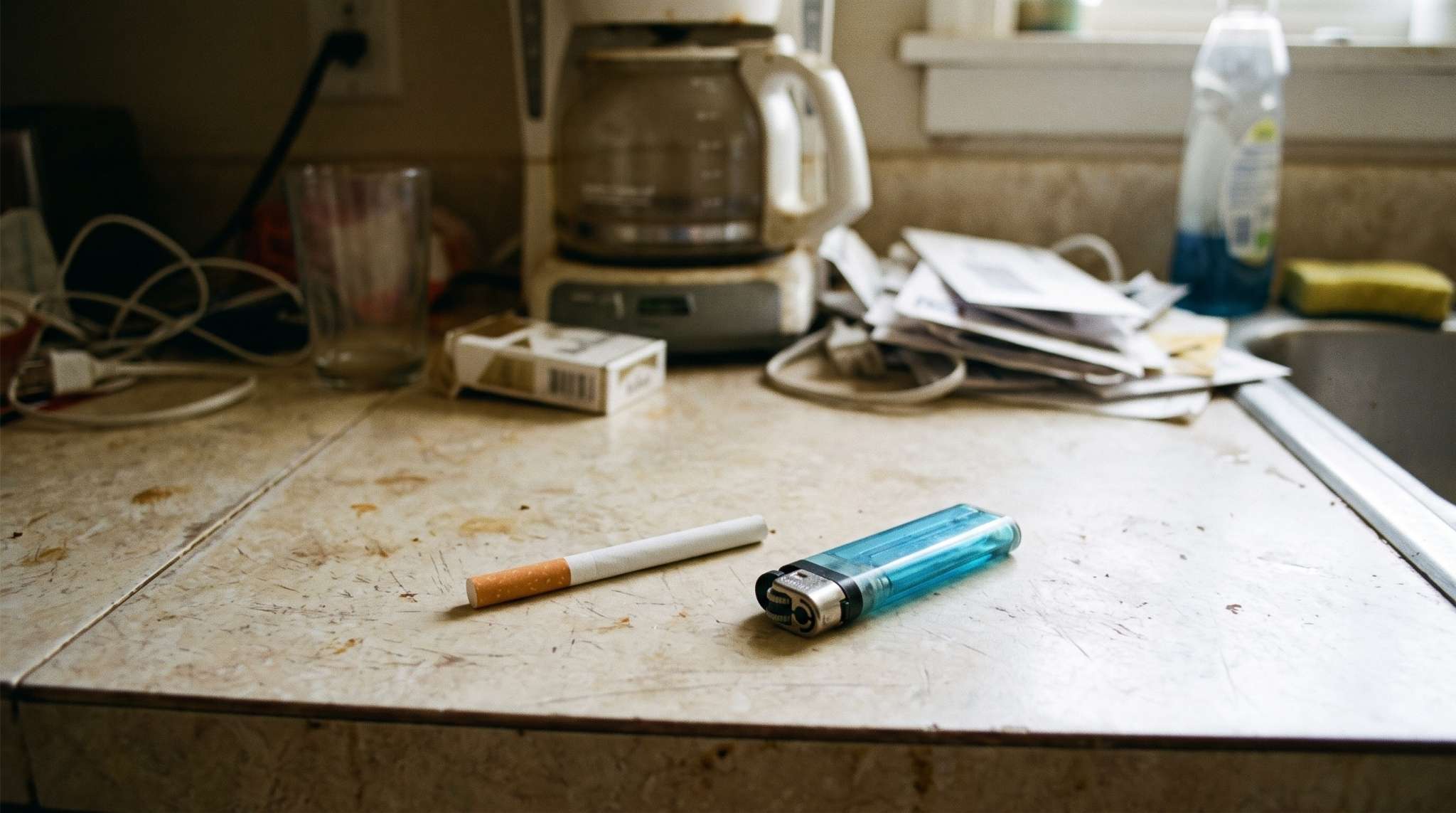
One morning in week three, the sequence ran unchecked until the exact moment I felt the cold filter against my lips and the metal ridges of the lighter wheel under my thumb. I immediately took my thumb off the striker, pulled the cigarette from my mouth, and placed both flat on the kitchen counter. I applied the strict fallback rule for late detection: an automatic reach is not a total collapse, but the ignition sequence must be suspended until three full cycles of 4-4-4 breathing are completed. I stood at the counter, ran the breathing cycles while looking at the cigarette, and smoked it exactly five minutes later.
The Thermodynamic Reality
The mechanical win was salvaged because I successfully forced a physical gap between the empty coffee cup and the first inhale. However, smoking inside the 90-minute DAWN COMMAND window triggers an Entropic Leak—a biological penalty in the engine. The victory was that the 5-minute delay pushed the cigarette further away from the CRITICAL severity band (≤5 min from waking) and closer to the HIGH band (6–30 min), actively reducing the biological penalty compared to an immediate capitulation.
Log the cigarette to capture the gap

Success is not quitting tomorrow morning. Success is measuring the decoupling of the anchor loop. The Smoke Loop Intercept architecture does not require a manual journal of your feelings; it relies on exact timestamps and physical ledgers.
When you do finally smoke, log the cigarette entry immediately. The engine will automatically calculate the gap minutes since your wake time, derive your Fagerström severity, apply any penalties, and award your Morning Anchor tier stars.
Visit for Printable Smoking Heat Map
The 7-Day Shift: Over seven consecutive mornings, I ran the exact same 5-minute intercept rule starting at the final sip of coffee. The app’s telemetry proved the mechanical shift. On days one through three, my logged times resulted in CRITICAL severity penalties. By day four, the automatic reach stopped happening entirely. Even on mornings where I still logged a cigarette, the 5-minute wedge allowed me to push the entry deep enough into the morning to clear the first 30-minute block, securing positive negentropy. The empty coffee cup remained on the table while I waited out the timer in another room. Converting that blind morning reflex into a delayed, measured decision is the exact mechanism required to eventually hit the app’s 7-consecutive-day zero-cigarette quit-detection threshold.
For specific environmental constraints, review the protocols for the Driving / Commute Cigarette, and Work-Break Cigarette

About Saqib Ali Ateel:
Saqib Ali Ateel is a senior systems analyst and the Chief Architect of SmokeTally & Smoke Loop Intercept App. Drawing on his executive oversight of public infrastructures serving millions and his research as a PhD Scholar, he engineered the Smoke Loop Intercept Protocol to dismantle the smoking habit loop using objective telemetry rather than willpower or counseling theater. A former heavy smoker, Saqib utilized these precise mechanical baselines to intercept his own neurochemical hardware. When not working in official capacity or working on his PhD, he studies intersection of physics, biology, and human agency. Check Saqib’s details on LinkedIn.