Work-Break Cigarette Intercept When You Can’t Leave the Area
How do I build a smoke loop intercept protocol for the work-break cigarette (when I can’t leave the area)?
Start before your body makes the break visible. The intercept happens in the 10- to 30-second pre-movement window, using a seated 3-phase sequence designed to stop the stand-up routine without signaling anything to the people around you.
Trigger Interception & Urge Delay is a mechanical way to break a smoking craving before it becomes an automatic cigarette. Instead of trying to overpower the urge, you insert a short timed pause and a physical buffer between the cue, the spike, and the reach. The delay does not need to be long; it needs to be repeatable under stress. Below, you'll see how to apply that in commutes, coffee routines, work breaks, and other high-risk moments.
Catch the urge before your body starts the break sequence
The work-break cigarette loop does not begin when you walk out the door. It begins in the 10- to 30-second pre-movement window. This protocol is engineered exclusively for this window, utilizing implementation intentions to disrupt automatic habits before they become kinetic (McWilliams et al., 2019). If you are already standing or reaching, the window has closed; skip to troubleshooting and reset for the next cue. You must identify the physical cues your body generates as it prepares for the break.
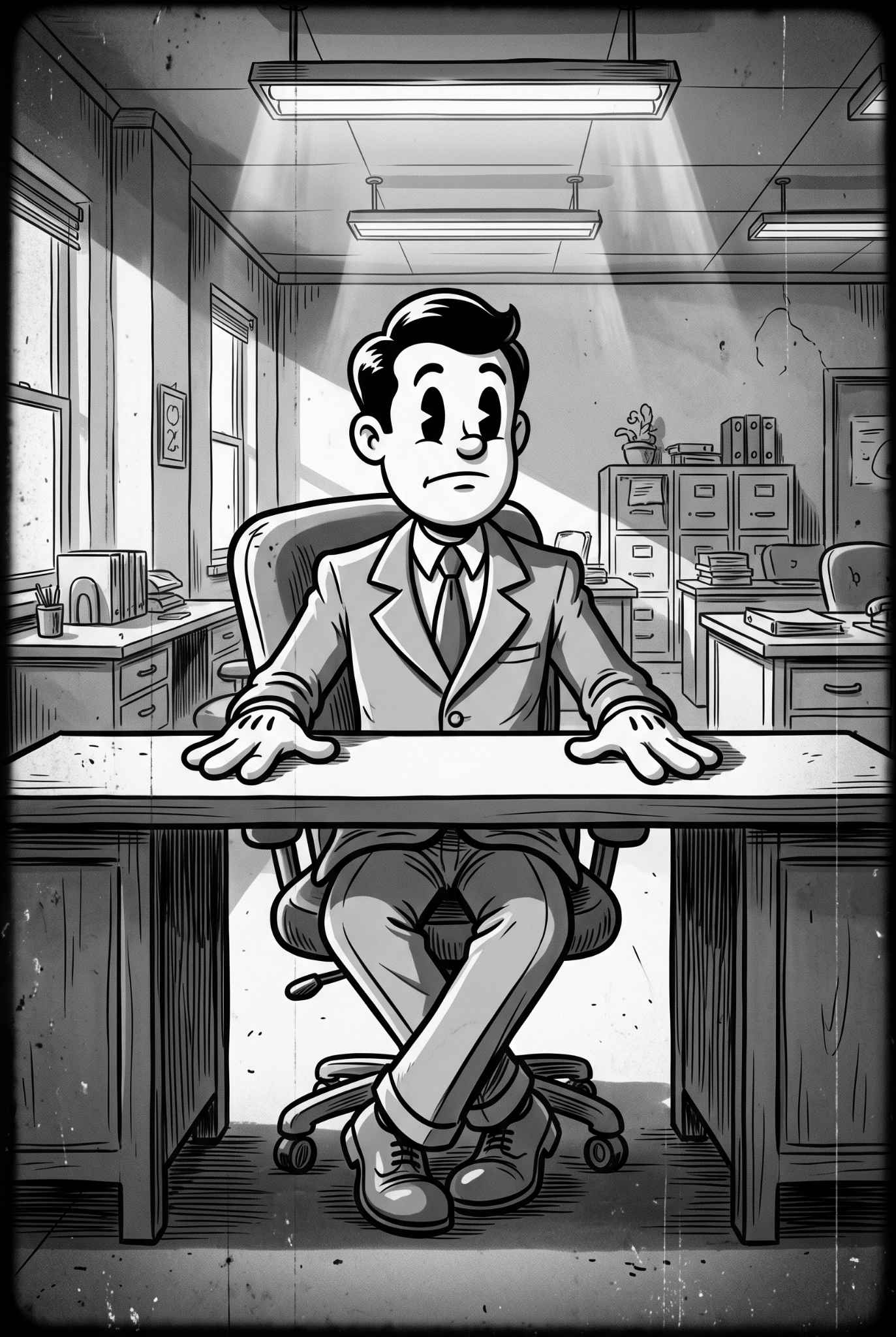
I sat at the head of a conference table in my office, leading a briefing on agricultural supply chain audits. In a room like this, any physical shift in my posture signals to twenty senior officials that it is time for a formal recess. At exactly 11:30 AM, ninety minutes into the continuous presentation, the loop triggered. It aligned perfectly with my standard mid-morning pacing gap.
The first signal was entirely internal. My focus shifted from the projector data to a micro-calculation. I realized if I handed the next slide to the deputy secretary, I would have a four-minute window to step onto the terrace. Almost immediately, the physical tells began. Beneath the table, I uncrossed my ankles and shifted my weight slightly forward onto the balls of my feet. My body was unconsciously preparing to stand.
The absolute point of no return arrived a second later. My right hand moved off my notepad and rested flat on the edge of the mahogany table, positioning to push myself up. The instant my palm touched the wood became the start line for the intercept. If I pressed down, my body would stand, and the break routine would lock in. I had exactly ten seconds to freeze the motion and execute the intercept while I was still seated.
Run the 3-phase seated intercept
When you identify your start signal, do not negotiate with the urge. Execute the following three phases in strict sequence while remaining seated.
Phase 1: Micro-delay
Create an immediate system pause. When you recognize the physical tell, freeze the motion. Halt any new movement toward standing for 10 to 30 seconds. Do not freeze completely into a rigid state. Maintain normal micro-movements like breathing and eye tracking, but apply zero downward pressure to launch.
Phase 2: Hidden physical anchor
Replace the gross movement of standing with a zero-visibility physical action. Ground the physical energy into a localized, unobservable point on your body or workstation. This disrupts the kinetic sequence without alerting colleagues (Dozier & Iwata, 2021).
Phase 3: Phone camouflage and single-tap Shield deployment
Use standard smartphone behavior as phone camouflage. Pick up your device, open your tracker, and deploy Shield with a single tap. This finalizes the circuit break privately while mimicking standard workplace behavior.
During that same formal policy meeting with twenty senior officials facing me, I couldn't break my speaking cadence, step away, or do visible breathing exercises. When my palm touched the mahogany table edge, the exact precursor to standing up, I initiated the micro-delay. I held my palm flat against the wood without pressing down. I sustained this lack of forward momentum for 15 seconds. To the outside observer, it looked like a standard resting posture. Actively suppressing the muscle tension in my forearms without visibly stiffening was the hardest part to execute without showing it.
Next, I drove my left heel hard into the carpet and curled my toes downward. This anchored the physical energy entirely below the table line, rendering it invisible. The first sign the loop de-escalated was the physical urge grounding into my foot, allowing the automatic tightness in my shoulders to drop. Finally, I picked up my phone, unlocked it with a thumbprint, and tapped the Shield button on the digital ledger. To an observer, this looked completely normal. It looked like an official checking a routine operational text or email. My facial expression remained neutral and engaged. The screen confirmed the Shield, and the acute physical necessity to stand dissolved into a manageable background craving. I placed the phone face down, shifted my weight back against the chairrest, and advanced to the next presentation slide.
Choose anchors nobody notices
The physical anchor must absorb the craving's kinetic energy without crossing the visibility threshold. In this specific setting, you must bypass the standard 4-4-4 vagal breathing protocol because it is too visible. Do not use generalized advice like stretching. Before deploying an anchor in a live setting, test it once in your actual seat. The rule is absolute. If the anchor changes anything above the desk line, like lifting your shoulders, shifting your neck, moving the desk itself, or tensing your jaw, it is disqualified.
The following are operational templates to test against your specific workstation sightlines.
Desk-based anchors
- Press
the pad of your thumb hard against the side of your index finger.
- Flatten
your palms against your thighs beneath the desk surface.
- Grip the underside edge of your desk and apply upward static pressure (ensure this does not lift your shoulders).
Leg, foot, and chair anchors
- Drive
your heels into the floor and flex your calves.
- Uncross
and tightly recross your ankles beneath the chair.
- Shift your center of gravity firmly into the backrest of the chair.
Use the phone as camouflage, not distraction
The smartphone is not a distraction tool; it is a deployment mechanism. Phone camouflage is permitted only if checking your device matches an existing, already accepted behavioral pattern in your exact setting. Using the device for phone camouflage gives you a socially bulletproof reason to break eye contact, pause a conversation, or ignore your surroundings for a few seconds.
If a quick glance at your phone reads as deviant under your supervisor, or your environment strictly prohibits phone use, replace the phone with a mechanical pocket tally counter or a printed ledger. The close action must be executable with no new reach and no obvious hand path change. Position your tool beforehand so the physical mark requires zero visible travel.

During an audit of a municipal waste facility, I was seated at a cramped operational desk between the facility director and the chief engineer. Any overt sign of stress or distraction from the financial logs would immediately be interpreted as administrative hesitation or weakness. The phone check looked identical to my standard behavior of verifying an incoming operational update from my head office. It gave me a socially bulletproof reason to break eye contact for seven seconds, creating a localized visual barrier while my thumb ran the single-tap Shield deployment on the tracker. My facial expression remained locked in a professional, slightly impatient configuration.
I deliberately avoided pushing my chair back from the table, taking a sudden deep breath, or breaking the conversational silence to clear my throat. These behaviors signal physiological tension or the management of cravings. The haptic feedback pulse from the Shield deployment confirmed the intercept was finalized. I immediately raised my head, locked eyes with the facility director again, and pointed directly at a discrepancy in the fuel consumption column without missing a beat.
Know what counts as a successful intercept
Perfection is a flawed metric. The objective is to keep the body in the chair and disrupt the automatic standing sequence. Evaluate the protocol based on loop interruption.
A full intercept
A full intercept occurs when you complete all three phases, and the urge to physically leave the area fully dissipates. You remain seated, the Shield is deployed, and the kinetic sequence is broken (Potvin et al., 2015).
A partial intercept
A partial intercept occurs when the protocol softens or delays the urge, but a residual craving remains. If you stayed in the chair for the 10 to 30 second window and deployed the Shield, the intercept was successful. The circuit was disrupted, even if the biological pressure takes longer to fade.
Troubleshoot the failure point in the sequence
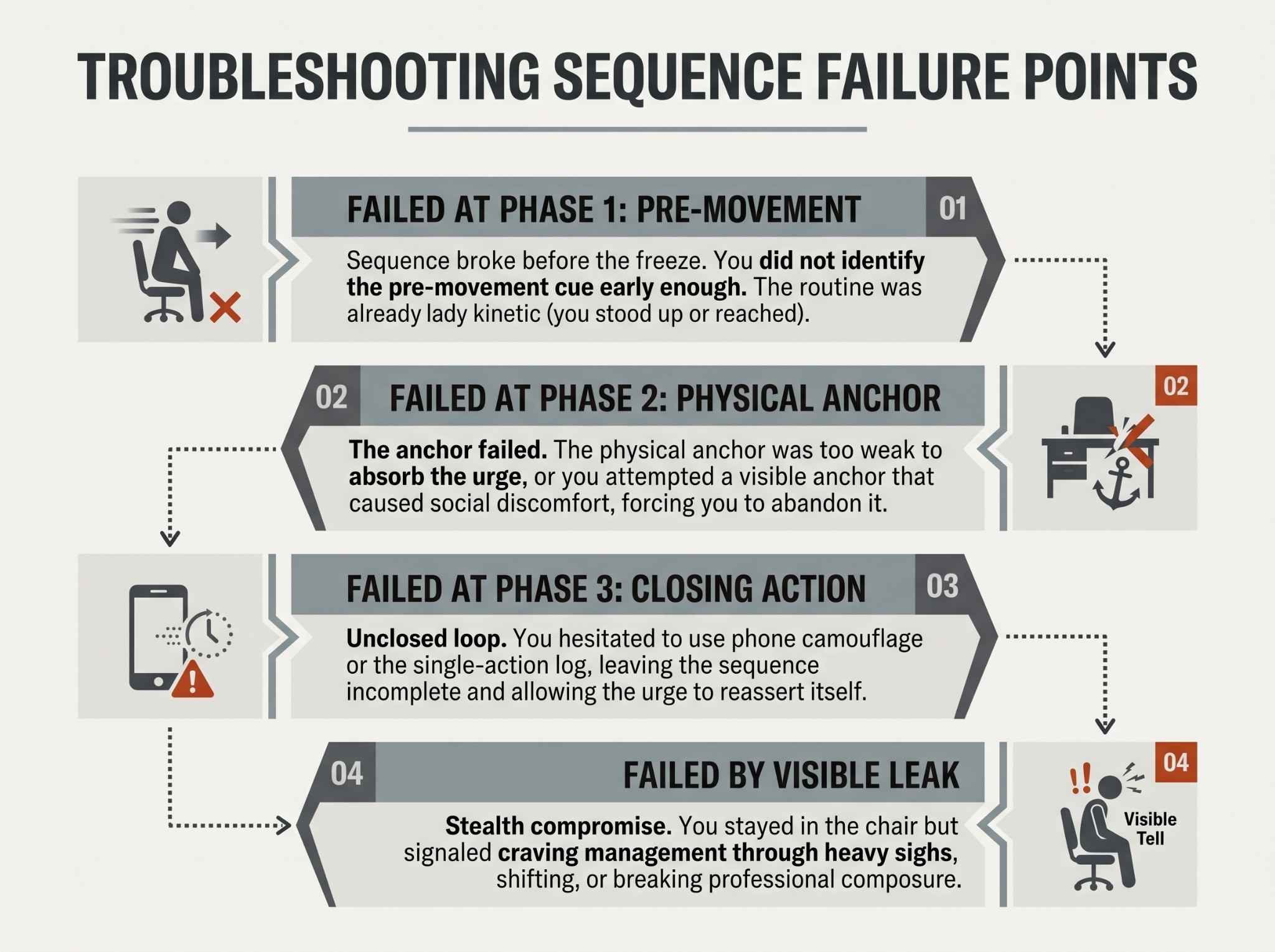
When an intercept fails, analyze where the sequence broke down to correct the protocol for the next cue.
- Failed
at Phase 1: You did not identify the pre-movement cue early enough.
The routine was already kinetic.
- Failed
at Phase 2: The physical anchor was too weak to absorb the urge, or
you attempted a visible anchor that caused social discomfort, forcing you
to abandon it.
- Failed
at Phase 3: You hesitated to use phone camouflage, leaving the
sequence unclosed and allowing the urge to reassert itself.
- Failed by visible leak: You stayed in the chair but signaled craving management through heavy sighs, shifting, or breaking professional composure, compromising the stealth constraint.
Build a repeatable protocol for your own work setting
The core mechanics of this protocol remain consistent across most workplace constraints. Whether you are at a corporate desk, a retail counter, or a monitored control station, the rule is the same. Isolate the 10 to 30 second pre-movement window, apply a zero-visibility physical anchor, and close the loop using phone camouflage and a single-tap Shield deployment.
To understand the broader behavioral mechanics behind this constraint-based protocol, read the core smoke loop intercept framework.

About Saqib Ali Ateel:
Saqib Ali Ateel is a senior systems analyst and the Chief Architect of SmokeTally & Smoke Loop Intercept App. Drawing on his executive oversight of public infrastructures serving millions and his research as a PhD Scholar, he engineered the Smoke Loop Intercept Protocol to dismantle the smoking habit loop using objective telemetry rather than willpower or counseling theater. A former heavy smoker, Saqib utilized these precise mechanical baselines to intercept his own neurochemical hardware. When not working in official capacity or working on his PhD, he studies intersection of physics, biology, and human agency. Check Saqib’s details on LinkedIn.