High-Stress Day Smoking Reduction Plan
A High-Stress Day Smoking Reduction Plan operates as a mandatory containment protocol when severe cognitive load fractures your focus and breaks your pacing in real time. If you are trapped in an audit or operational crisis and a time-calculation loop overrides your primary task, willpower will fail; you need a pre-engineered fallback. This manual details the exact switch from baseline reduction to Stress-Day containment: triggering the cap, locking in forced delays, deploying offline tracking, and executing a mathematical reset to prevent a thermodynamic overrun.
A High-Stress Day Smoking Reduction Plan is a containment protocol for days when severe cognitive load makes baseline pacing unstable.
- Instead of relying on willpower, it shifts you to a preset cap, fixed smoke windows, and offline tracking to prevent a full relapse.
- If the cap is used, the system absorbs the penalty and allows an immediate restart of your original taper the next day.
- The page explains the trigger rule, 4-4-4 Vagal Intercept, pocket-ledger logging, and Sleep Perimeter closeout.
Willpower
Fails on a High-Stress Day…Why?
Willpower is strictly a sunny-day system. It lacks the structural integrity to function under severe cognitive load. To survive, operators must deploy pre-engineered architecture the moment cognitive stress exceeds normal parameters—a state that threatens to drastically drive up the operator’s thermodynamics tax (T(t)) strictly because the resulting extra cigarettes spike the system's entropy load. I operationally define this cognitive threshold as any state in which resting respiratory rate elevates, and task focus cannot be maintained for more than fifteen continuous minutes.
I recognized this exact physiological threshold during a high-stakes municipal audit. A strict deadline trapped me in a hostile, six-hour boardroom inspection. The threshold signal was measurable: my focus on the audit ledger fractured, and I felt the physical impulse to step out for a cigarette three times within a ten-minute window. Operationally, I define a "spike" using a strict physical metric: any urge severe enough to force a break in visual contact with the primary focal point (e.g., the physical ledger or the active speaker).
I invoked the system's core diagnostic rule: if cognitive load forces three visual-break spikes within a single, unbroken task session, baseline reduction is suspended, and Stress-Day containment mode activates. I immediately engaged the containment cap, overriding my then 4-cigarette baseline and deploying my Plan B emergency ceiling. While this ceiling mathematically caps a worst-case breach at double the baseline (e.g., 8 cigarettes for a 4-cigarette baseline), it is an absolute maximum limit, never an authorized quota or an invitation to smoke. I hard-locked this new parameter by mapping the 8 cigarettes to rigid 90-minute forced-delay intervals, completely removing the choice of when to smoke.
Note: The Smoke Loop Intercept app's pacing actively helps restrict consumption even under crisis. The containment cap is a fail-safe, not a free pass. Your primary objective is to remain strictly on your original taper even on a high-stress day.
Verification was immediate and observable: with the biological system under a guaranteed field tourniquet locked into the timeline, background decision noise vanished, and unprompted physical urges dropped back to zero. Using this cap incurs massive entropy penalties in the engine that must be worked off later, but it successfully prevents total system collapse.
Core Objective: Damage Containment
Under high cognitive load, success is not perfect baseline compliance. It is strictly damage containment. The primary objective is to prevent a single off-schedule cigarette from compounding into a thermodynamic overrun event, operationally defined as a catastrophic fracture of the baseline pacing gap.
According to the system's Meaning Equation, discipline executed under high thermal stress mathematically generates a higher Meaning Yield (exergy), measured strictly in virtual Joules (vJ) of negentropy credit. However, this amplification only activates if your structural restraint mathematically defeats the day's disorder. Relying on the 8-cigarette containment cap generates zero Meaning Yield; the math clamps to zero because the entropy penalty outweighs the restraint. The cap is strictly a survival shield. But if your pre-engineered architecture holds consumption to your baseline despite the hostile environment, that high-stress day becomes a high-yield biological opportunity to extract permanent structural order from chaos.
Containment Architecture
Operating in containment mode requires abandoning abstract goals and executing specific mechanical protocols. If you are trapped in the Occupational Field facing circadian disruption (defined as sustained operations extending past 20:00) or prolonged operational crises, you must actively defend against cortisol accumulation. I experienced this during a prolonged administrative inspection: a high-scrutiny boardroom where I couldn't break eye contact or leave the room. The threshold signal was measurable: a shift to shallow clavicular breathing accompanied by a recurring mental loop calculating the minutes until I could exit to smoke. I applied the system rule: if the time-calculation loop initiates, execute the Vagal Intercept.
In this architecture, 4-4-4 is strictly defined as a 4-second nasal inhale, a 4-second breath suspension with lungs expanded and zero abdominal tension, and a 4-second controlled nasal exhale. I ran exactly three consecutive cycles, concealing the intervention by maintaining a fixed gaze on the active speaker and keeping my jaw slack to render the respiratory shift invisible. The verification was immediate: the smoking loop broke, and the physical impulse to shift my weight toward the exit ceased. If the smoking loop re-initiates during the same task session, the three-cycle intercept is re-authorized.
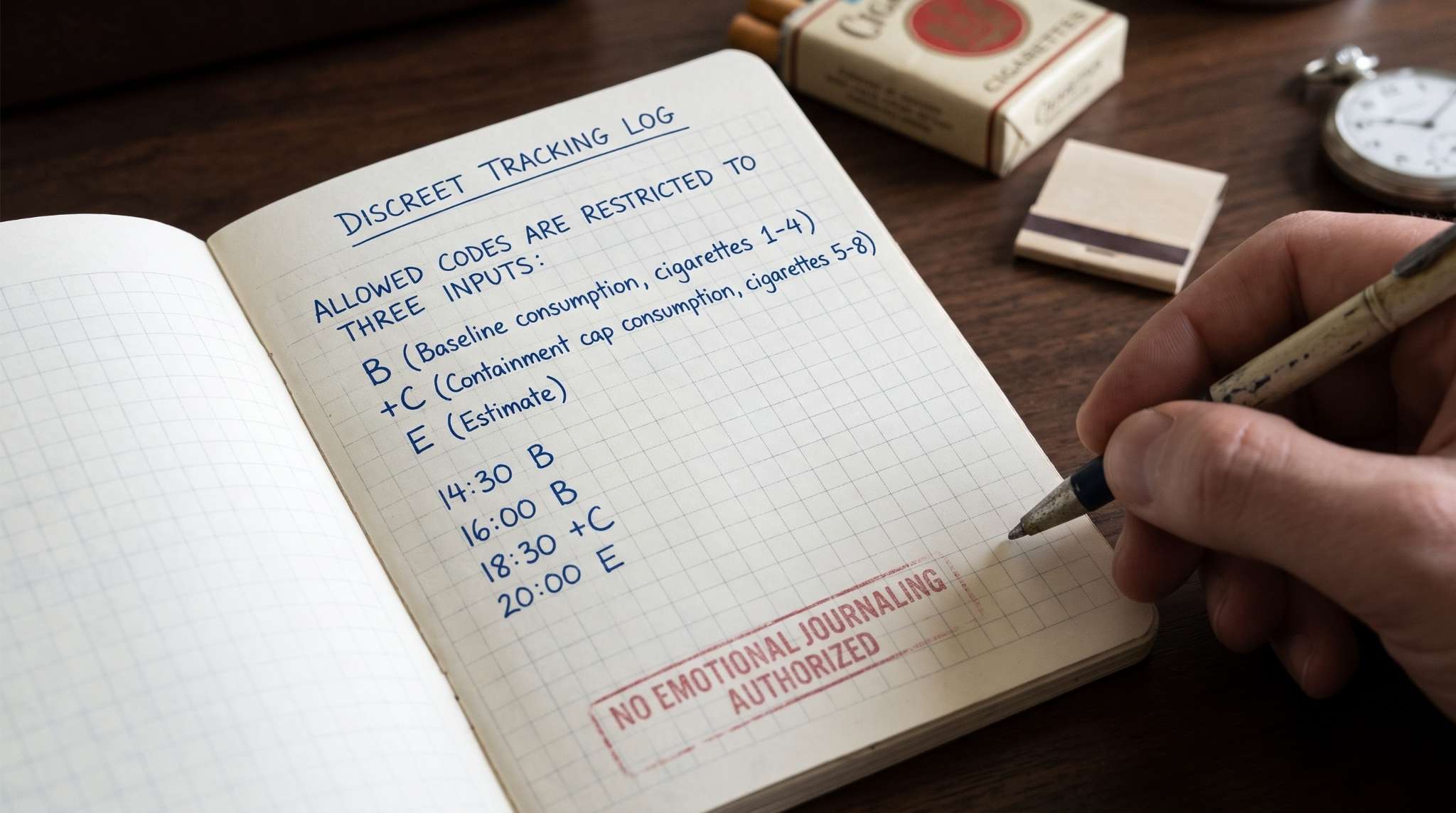
When cognitive load maxes out, active real-time data entry can fail. Therefore, I deploy Discreet Tracking as an offline buffer: a strictly zero-friction protocol. The tracking medium is a folded paper ledger carried in a pocket and accessed only during physical transit out of the Occupational Field. Log only when a physical cigarette is consumed. Record the timestamp and the variance code, nothing else. No emotional journaling is authorized. Allowed codes are restricted to three inputs: B (Baseline consumption, cigarettes 1-4), +C (Containment cap consumption, cigarettes 5-8), and E (Estimate). If an entry is delayed past the transit window, log the timestamp with an E flag to prevent data hallucination. If the ledger is compromised or exposed, destroy it immediately. Data preservation is secondary to operational privacy. This log feeds the end-of-day reset by providing the objective containment utilization count required to calculate tomorrow's baseline recovery logic.
To prepare for the reset, you must secure the Sleep Perimeter. I learned this after a mid-afternoon breach where I approached my emergency containment ceiling due to an unforeseen audit escalation. The 2-hour Sleep Perimeter begins exactly 120 minutes before physical lights-out. Inside the perimeter, all occupational digital inputs and cognitive problem-solving are strictly forbidden. Only strictly offline, low-bandwidth routines requiring zero active decision-making (e.g., reading analog text) are authorized. Nicotine consumption is hard-locked at zero, enforced by physically locking the remaining supply inside a vehicle parked outside the residence. The next morning, I verified containment by confirming a stable resting respiratory rate and zero physical nicotine-seeking impulse inside my Dawn Command window, which I operationally execute as a strict zero-consumption block between waking and the first occupational task—a personalized, maximum-security variant of the engine’s standard 150-minute graduated morning tiers.
System Integration and The Reset
A high-stress day must close mechanically. Run the reset either the moment a mid-day operational crisis formally concludes, or as a mandatory protocol at the exact start of the Sleep Perimeter. Read the pocket ledger in strict privacy and compute the objective containment utilization count (total +C entries). If any entries carry an E (Estimate) flag, mechanically convert them to a +C to guarantee the system assumes maximum thermal load and prevents data hallucination.
This output drives tomorrow’s baseline recovery logic based on strict precedence: if the containment cap was utilized (any +C entries logged), the Smoke Loop Intercept architecture provides its greatest advantage. Because the app's mechanics restricted the binge and prevented a total collapse, tomorrow does not require a punitive pause. You simply clear the entropy penalty and immediately restart your original reduction taper. Sync data from the disposable pocket ledger to the permanent Master Tracker at base to update the engine. If the +C count is strictly zero, tomorrow resumes standard Baseline pacing. End the reset by immediately destroying the paper ledger, halting any psychological rumination, and closing the day strictly on the math.
This methodology depends entirely on preemptive construction. Architecture built during a crisis will fail. You must internalize these fallback parameters while your biological system is stable, allowing you to permanently convert cognitive stress into crystallized behavioral capital.

About Saqib Ali Ateel:
Saqib Ali Ateel is a senior systems analyst and the Chief Architect of SmokeTally & Smoke Loop Intercept App. Drawing on his executive oversight of public infrastructures serving millions and his research as a PhD Scholar, he engineered the Smoke Loop Intercept Protocol to dismantle the smoking habit loop using objective telemetry rather than willpower or counseling theater. A former heavy smoker, Saqib utilized these precise mechanical baselines to intercept his own neurochemical hardware. When not working in official capacity or working on his PhD, he studies intersection of physics, biology, and human agency. Check Saqib’s details on LinkedIn.
- Home
- Stress Protocols
- Stress Day